There is consolation in the way the earth continues to spin
For the past several years, I’ve hosted a solstice event called “Darkness Into Light”, where we optimistically focus on the longer days to come.
This year, I just couldn’t do it. Because frankly, every day since sometime in January of 2025 has been one damned thing after another, much of it not good.
Then New Year’s Eve came, and it felt more like “good riddance to 2025” than “woohoo! a brand new 2026!”
So I asked myself, what is there to celebrate?
The answer, as it turns out, is how we endure.
The sun rises. The sun sets.
The moon circles round the earth, pulling on the seas. The tides rise. The tides fall.
The earth orbits the sun, in constant motion on its axis, while on the surface the winds blow, the tides change, and the seasons slowly shift—spring into summer, summer into fall, fall into winter…
There are the four main seasons, of course, and we move through each in turn, but things shift and change daily. Perhaps it is not “officially” winter yet, but the cold (or cooler) days outnumber the hot ones in the northern hemisphere now, and the leaves have let go of the trees to lighten the weight of the branches as wind and snow approaches.
The constant small shifts are noticeable—so noticeable, in fact, that the Japanese recognize 24 seasons, split further into 72 micro seasons based on close observation of nature, lasting only a few days each.
We tend to view things very parochially in our daily lives: what we see and do, perhaps with reference to our families or co-workers, and how the events of the day affect us, our loved ones, and (being social animals) the various groups we attach ourselves to. Maybe it’s a religious group, a city, a state, or a group of people with similar characteristics.
(Stick with me—this is going somewhere.)
We locate ourselves beginning with the micro: our room, in our house, in our town, in our state or province, in our country, on our continent. Our planet in our solar system, in our galaxy, in our universe.
The farther out we go, the smaller we (and our lives) appear as we look back.
Call me crazy, but I find comfort in knowing that we are none of us the be-all and end-all in this universe. At the same time, each of us is as unique as a grain of sand in the beach. Below is an extreme close-up of actual sand, to give you an idea what that might mean:
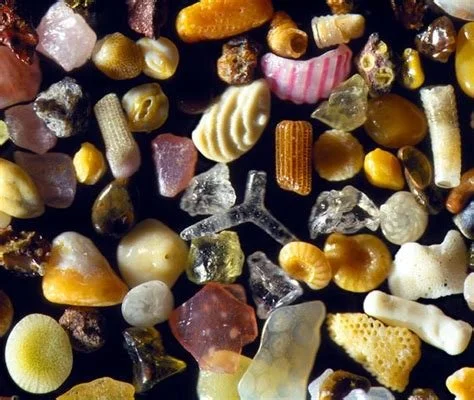
Sand magnified lots and lots
Each day on earth there is darkness, and there is light. There is struggle, and there is singing. There is contrast, and there is change, and all of it is eternal.
Even if “oceans rise, empires fall,” as King George sings in Hamilton, the world still spins, the seasons pass from one to another. Administrations and wars come and go, prices rise and fall, but things like the solstice and the turn of the calendar pages endure without regard to what we think or say about them.
There is comfort to be found in the way nature persists, and persists in changing.
In a darkening world—both literally in these short days, and metaphorically given the state of the world—it can be easy to lose touch with nature, and the example it sets for us by enduring whether we pay close attention or not.
Everything is cyclical.
Everything is cyclical, which is true whether we speak of the tides, of seasons, of politics, or even of the arc of moral justice.
As I hung my new calendar on the wall last night to prepare to welcome in 2026 (it’s THIS ONE from Pamela Zagarenski), I paid attention to the artwork for January, which includes both an image and a text.
The text for the month of January, 2026 is a metta meditation. It begins “May I be happy”, then adds wishes for health, safety, peace and ease, lovingkindness and freedom. Then “May You be happy.” And then “May all beings be Happy.”
There’s something reassuring about it, and also it forms its own cycle: I look first at myself, then at you, then extend lovingkindness to all beings, which in my personal belief includes animals and plant life.
I have met many trees, and consider them beings. Some whisper to me of sorrow, some of anger or hurt, many of them of wishes for happiness and peace . . . their own version of extending metta (or lovingkindness) to the world.
Trees (especially deciduous trees) live cyclically: they bud or blossom, then leaf out, then their leaves change color and being to fall, then release for the winter to allow the branches to let the winds blow freely through and to limit the weight the tree must bear when the snow and ice comes. They breathe in carbon dioxide and photosynthesize it for us so that we have oxygen; they clear impurities from the air when they are able.
Cycles within cycles. Wheels within wheels.
And now the calendar page says January, and though there is a lot to be worried or angry or upset about in this world of ours, the wheel keeps turning and soon it will be Imbolc, when we honor the quickening of life within the earth despite the outward appearance of winter. I will be offering an Imbolc gathering on Sunday, February 1st. I hope you will join me. Details coming soon!