Memorial Day
Did you know that the earliest Memorial Day was celebrated in Charleston, South Carolina, just after the Civil War by African Americans? They were remembering several hundred Union soldiers buried in a mass grave at a prison camp run by the Confederacy. Freed enslaved people gave the Union soldiers proper burials in early May of 1865.
On May 30, 1868, Gen. John A. Logan of the Grand Army of the Republic, an organization of former Union sailors and soldiers, declared the first widely-observed “Decoration Day”, in which the graves of fallen soldiers were decorated in remembrance of their sacrifice. It eventually became a state holiday in various places, and following World War I, its observation was extended to remember soldiers who died in all wars on behalf of the United States.
It is odd to me, as the United States has committed troops to fight in Venezuela and Iran and is making noise about Cuba and possibly other places (be safe, Greenland!), that there has been so little attention paid to the human cost. I remain skeptical that US losses are only 13 persons. We haven’t been told about injuries. There’s been no effort to address the Veterans Administration and what sort of medical care, including mental healthcare, will be needed, or to expand treatment for those veterans of past wars.
As I’ve driven past the local ambulance center in my town this month, I’ve seen more and more small American flags planted in the grass—an attempt to draw attention to the suicide rate of US veterans. According to the signs, 22 veterans a day (on average) commit suicide here in the US. Yet the administration blithely sends people off to war without consideration of the mental and physical costs.
Maybe I digress, but I don’t think so. Today is a day to remember the soldiers who died, and that should include all of them, even those who took their lives after coming home (and being left in the lurch by the system).
Today, I am sharing one of the best-known war poems of all time.
This poem sticks with you, so if you’ve ever read it, I’m sure it will resonate now. If you’ve ever been to the graveyards in Normandy, which are from the Second World War, or to any of the WWI graveyards, it may even haunt you. The remainder of this post is taken from a post I wrote 14 years ago when I was part of the Live Journal community, and has been lightly edited.
Today’s poem is not just a war poem, but is also the best-known rondeau in the English language. And although it is Memorial Day in the United States today, this poem was written by a Canadian poet. But when a poem is right for the day, it's right for the day.
In Flanders Fields
by John McCrae
In Flanders fields the poppies blow
Between the crosses, row on row,
That mark our place; and in the sky
The larks, still bravely singing, fly
Scarce heard amid the guns below.
We are the Dead. Short days ago
We lived, felt dawn, saw sunset glow,
Loved, and were loved, and now we lie
In Flanders fields.
Take up our quarrel with the foe:
To you from failing hands we throw
The torch; be yours to hold it high.
If ye break faith with us who die
We shall not sleep, though poppies grow
In Flanders fields.
Discussion of the poem, for the poetically interested:
As already mentioned, it's a rondeau. The "chorus" line of the poem is, in this case, derived from the first three words of the poem: "In Flanders fields". Apart from that line, the poem is written in iambic tetrameter (four iambic feet per line, taDUM taDUM taDUM taDUM), with end-rhyme options of "I" or "O". The first stanza has five lines, the second four, and the last stanza has six lines. The rhyme scheme is: AABBA AABX AABBAX (with X representing the shorter refrain "In Flanders fields", which is not rhymed to any other line).
This is one of the most famous of the War Poems from the First World War. It is frequently misprinted (including at The Academy of American Poets) using "grow" in the first line, but "blow" is actually correct. Flanders is, for those who aren't aware, an older name for the Flemish or Dutch-speaking portion of what is now called Belgium.
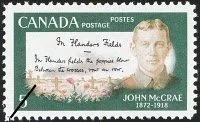
A Canadian postage stamp that featured John McCrae
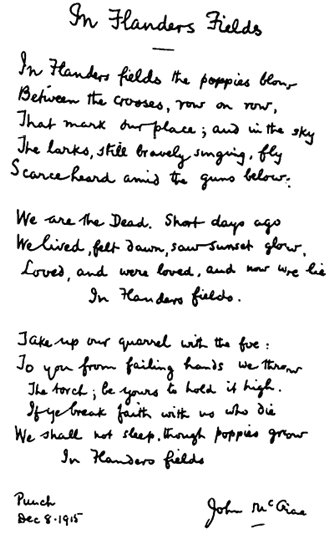
You can see the start of his hand-written poem on the face of the stamp as well. The full image is below.
About John McCrae: McCrae was a Canadian who trained as a doctor. He trained two of the first female doctors in Canada prior to enlisting in the military. He served in battle, and was none-too-happy when he was diverted from the field and sent to organize a medical unit. In fact, he is quoted as having said, "[A]ll the goddamn doctors in the world will not win this bloody war: what we need is more and more fighting men." His poem, "In Flanders Field", became internationally famous during his lifetime, and he regarded its success with detached amusement, although he was pleased that it was used to remind young men "where their duty lay". The first stanza of the poem is on the reverse side of the Canadian $10 bill. Because so many folks substitute "grow" for "blow" in the first line (in error), rumors abounded that the Bank of Canada got it wrong and was recalling the $10 bills. The first stanza of the poem is, in fact, correct, and any rumors of a recall are false.
McCrae died of pneumonia in 1918 while working at a war hospital in Boulogne, and is buried in France. Below is an image of the poem in his own writing after it was published in Punch in 1915. (McCrae initially threw it out, but a fellow soldier named Edward Morrison salvaged it and submit it to Punch magazine. It initially appeared anonymously, but was rapidly identified as McCrae's work.)